Docker for Ruby applications

- We <3 Ruby
- We <3 SOA
- We <3 code quality
- We <3 AI
- The biggest YouTube advertising platform there is
- 40+ people in Cracow
- 35 applications / 8 internal gems
- Apps with up to 700 requests/s
Let's talk about cargo shipping!

Let's talk about cargo shipping!
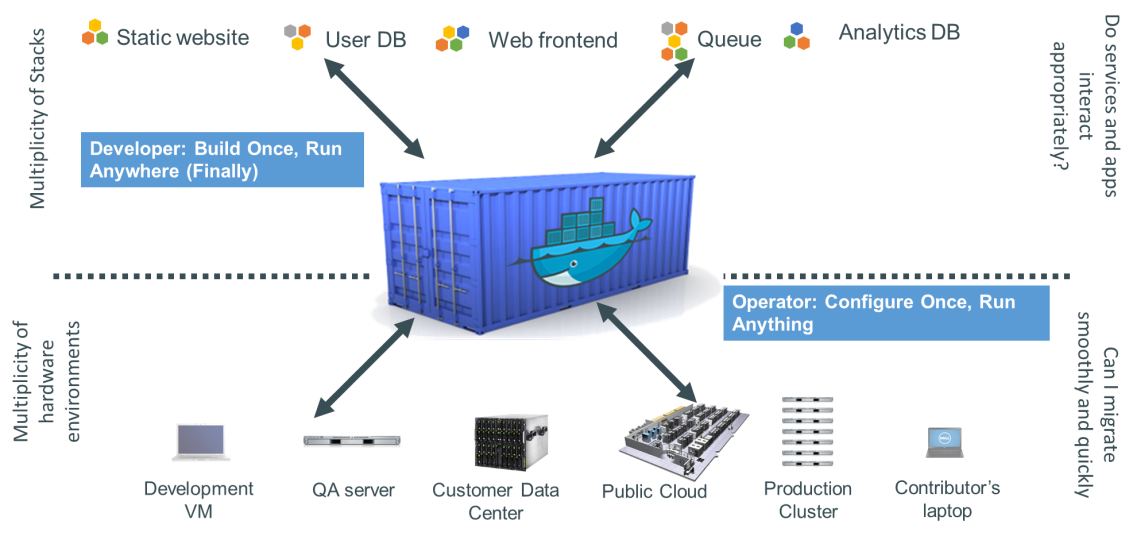
- Goods shouldn't worry about cargo
- Destination shouldn't matter (from goods perspective)
- Multiple goods types
- Goods should not interact
- The whole process should be transparent for them
Goods can be packed into containers!
Software can be packed into Docker containers!
Let's talk about Docker!
What is Docker?
Docker is an open platform for developers and sysadmins to build, ship, and run distributed applications.
Thanks to Docker, IT can ship faster and run the same app, unchanged, on laptops, data center VMs, and any cloud.
What Docker brings to the table?
- Reusable layers (union mount)
- Great portability
- No more dependency hell
- Separate process namespace
- Flexible but not ideal network solution
- Public and free Docker registry with various base images
Container != Virtual Machine
- Processes run by Docker share the host kernel
- No devise emulation
- Architectures and platforms between host and container must match
- Since we need only a valid kerner (>= 3.8), Distro doesn't matter
Let's talk about building images!
FROM ruby:2.2.1

RUN mkdir -p /usr/src/app

WORKDIR /usr/src/app

ONBUILD COPY Gemfile /usr/src/app/
ONBUILD COPY Gemfile.lock /usr/src/app/
ONBUILD RUN bundle install
ONBUILD COPY . /usr/src/app
docker build -t "app_name:tags" ./path
Let's talk about Ruby apps images!
- Ain't so easy :-(
- Apps are not single process based anymore
- It is a bit more complex for bigger apps
- Doesn't work with private git repositories
- Doesn't work with private gems
- Doesn't work without exposing a SSH key
- Too much caching
- Bundler is a pain in the ass
But why?
Most of the troubles comes from how Docker build works
Almost everything can be fixed or bypassed
Bigger apps - more images
- Multi process images are not scalable
- Who needs to scale crontab? ;) (chronos)
- There's no strict rule on how many Pumas, Sidekiqs, etc, will we need
- Single process images can be used to scale in any direction

Decompose!
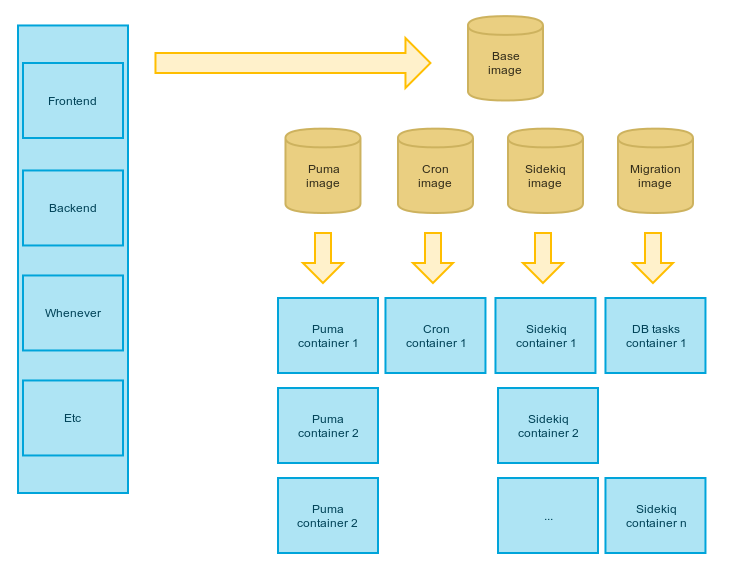
Multiple images mean multiple Dockerfiles
Instead of playing with Docker let's fix that in Ruby - simple templates and a bit of magic:
name = "#{@app.container_name(:base)}:#{@app.build_tag}"
generator.build(:base)
system "docker build -t='#{name}' #{@app.location}"

@app.services.each do |type, enabled|
  next unless enabled

  generator.build(type)

  name = "#{@app.container_name(type)}:#{@app.build_tag}"

  system "docker build -t='#{name}' #{@app.location}"
  system "docker tag #{name} #{@app.container_name(type)}:latest"
end
Multiple images mean multiple Dockerfiles
# docker images | grep facebook
registry/facebook_api_production_base      latest
registry/facebook_api_production_mongoid   latest
registry/facebook_api_production_puma      latest
registry/facebook_api_production_sidekiq   latest
registry/facebook_api_production_whenever  latest
Dynamically generated templates will allow you to invalidate cache whenever you want (too much caching issue solved).
Private Git stuff (apps and gems)
- No easy way to injest your stuff to /etc/hosts
- Docker will cache your SSH key
- If it is cached it will be pushed
- If it was pushed it will be in the image
- If it is in the image it will be in the container
- If it is in the container someone might get it

Private Git stuff (apps and gems)
Just use temporary SSH key that works only during container build.
Details: http://dev.mensfeld.pl/?p=3153

Fat bundler issue
- Private gems require SSH key which invalidates cache
- Security vs build performance
- Local gem cache server as one of the solution (in development)
- Base image with system wide most used gems to speed up bundle install

Multiple apps - multiple settings
What about all the settings for all of the apps?
Settings repository
- Changes can be reviewed
- All the config stuff in one place
- Automatically fetched during builds
- Multiple environments
- Can be used to apply specific container settings
How to deploy it?
- Amazon Web Services (AWS)
- CoreOS
- Fleet
- Panamax
Issues?
- The more heterogeneous apps the harder it gets
- It's fairly new, so a lot of testing
- Might be slower than bundler during deploy
- We need to change the way we think about infrastructure
- Developers need to learn few new commands and tools
- Injecting hosts into containers during build is impossible
- Private gems equals bigger containers
- Harder debugging when everything is a Docker
- Harder debugging with ephemeral containers
- Harder monitoring
THE END - Q & A
PS: We're hiring at hello@striketech.pl